

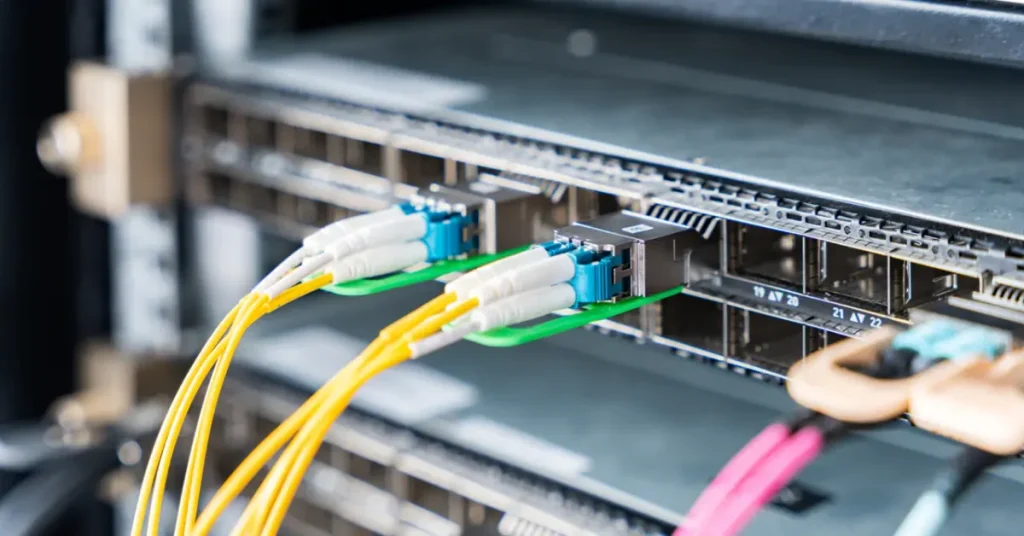
The rapid expansion of AI training clusters has fundamentally reshaped data center interconnect requirements. As GPU clusters scale from hundreds to thousands of nodes, east-west traffic between servers, ToR (Top-of-Rack) switches, and spine layers grows exponentially. In this context, 800G optical connectivity is no longer a forward-looking option, it is a present necessity. Among various 800G form factors, 800G FR4 is increasingly emerging as the default choice for AI cluster interconnect, particularly in ToR-to-Spine deployments.
AI Training Clusters: Bandwidth Density and Distance Requirements
Large-scale AI training environments generate massive all-to-all traffic patterns. Distributed training frameworks such as NCCL-based GPU fabrics rely heavily on low-latency, high-bandwidth links to maintain synchronization efficiency. Any bottleneck in the network directly affects GPU utilization and overall model training time.
In most AI cluster designs, the physical distance between ToR and spine switches typically ranges from 100 to 500 meters. This is especially common in medium-to-large data halls where spine layers are centrally positioned. Multimode optics may struggle to support these distances reliably at 800G speeds. As a result, single-mode solutions with greater reach and improved signal integrity become more attractive.
800G FR4 transceiver supports up to 2 km over single-mode fiber (SMF), providing ample distance margin for AI cluster layouts. This reach flexibility simplifies cabling design and reduces the need for intermediate aggregation layers.
ToR-to-Spine Connectivity: Why FR4 Fits Best
The 800G FR4 architecture typically uses 4 × 200G PAM4 lanes over four CWDM wavelengths on duplex single-mode fiber. This allows high bandwidth density while maintaining fiber efficiency. Unlike parallel optics that require eight fibers, FR4 operates over two fibers (one transmit, one receive), significantly reducing fiber count.
In AI clusters, where rack density is high and cable pathways are congested, reducing fiber consumption is not a minor optimization, it is a structural advantage. Duplex SMF infrastructure is easier to manage, easier to scale, and more aligned with modern hyperscale cabling standards.
Moreover, FR4 modules integrate DSP technology capable of handling PAM4 modulation with improved signal equalization. This ensures better link stability over longer distances, which is critical in high-power GPU clusters where electromagnetic noise and thermal factors can impact performance.
800G FR4 vs 800G DR8: A Practical Comparison
The 800G DR8 is another popular 800G optical solution, particularly for short-reach intra-data center links. DR8 utilizes 8 × 100G PAM4 lanes over parallel single-mode fibers and typically supports distances of up to 500 meters.
While DR8 excels in very short, high-density environments, such as direct switch-to-switch connections within the same row, it requires eight fiber pairs (16 fibers total in typical MTP/MPO configurations). This increases cabling complexity and consumes more fiber resources.
In contrast, FR4’s duplex fiber design significantly lowers infrastructure overhead. For AI clusters scaling to thousands of ports, the difference in fiber count translates into tangible savings in cabling trays, patch panels, and operational complexity.
Additionally, FR4’s 2 km reach provides architectural flexibility. Data center operators can centralize spine layers or distribute GPU clusters across multiple halls without being constrained by reach limitations.
Single-Mode vs Multimode: The Direction of High-Speed Interconnects
At 800G speeds, multimode fiber (MMF) faces practical and economic limitations. Short reach, higher insertion loss sensitivity, and scalability challenges make MMF less suitable for rapidly expanding AI fabrics.
Single-mode fiber, on the other hand, offers:
Longer reach
Better future-proofing for 1.6T evolution
Lower attenuation over distance
Greater compatibility with emerging coherent technologies
As AI clusters become larger and more geographically distributed within facilities, single-mode infrastructure is increasingly seen as the long-term strategy. 800G FR4 aligns perfectly with this trend.
Conclusion
The dominance of 800G FR4 in AI cluster interconnect is not accidental. It strikes a balance between reach, fiber efficiency, power consumption, and architectural flexibility. In ToR-to-Spine deployments, arguably the most critical layer in AI fabrics, FR4 offers the scalability and manageability that hyperscale and enterprise AI operators demand.
While DR8 remains valuable for ultra-short links, FR4’s duplex single-mode design and extended reach make it the more versatile and future-ready option. As AI workloads continue to push bandwidth boundaries, 800G FR4 is rapidly becoming not just a preferred solution—but the practical default for next-generation AI data center networks.


